

CIO Weekly - The Undercurrent
The suspicious rescue operation provided a critical clue on the ceasefire, and some interesting development in North East Asia.

Summary
This week, we delve behind the scenes of the pivotal ceasefire that extricated Trump from his ultimatum, roiled global oil markets, and kindled a measure of cautious optimism in risk assets. Envoys from Iran and the US are currently en route to the negotiating venue—and while the Middle East landscape remains highly fluid and subject to rapid shifts—we assess that a critical inflection point may be imminent. We will subsequently offer insights into developments involving Japan and the Korean Peninsula, before concluding with our weekly Risk Alert.
The Anatomy of the Rescue
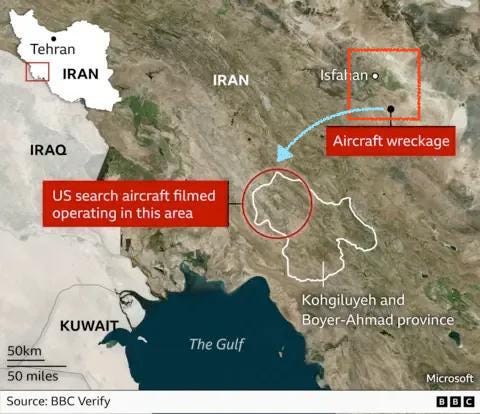
The Iran theater of operations has yielded what the Pentagon described as “the most audacious rescue mission in history.” Yet a forensic examination of crash debris, topographical data, and satellite imagery suggests a narrative far less tidy than the official account. Anomalies abound. The ejection site of the F-15 pilot was located at a considerable remove from the actual rescue point—a distance that a severely injured aviator would have found exceedingly difficult to traverse alone across mountainous terrain spanning dozens of kilometers. Moreover, the recovery site featured the presence of C-130 transport aircraft configured to support special operations rotary assets, a resource typically reserved for deliberate assault planning rather than ad hoc extraction. The improvised airstrip utilized for the mission lies a scant 42.29 kilometers from Iran’s Isfahan nuclear complex.
The analysis posits that the remote, abandoned runway had been previously identified and prepared by American forces for a fundamentally different objective: a special operations raid on the Isfahan facility intended to seize fissile material. The shootdown of the F-15 and the subsequent imperative to recover the downed aircrew forced the premature activation of this forward staging area. In deploying assets to rescue the pilot, Washington inadvertently illuminated the infrastructure and intent behind a broader, covert operation aimed at Iran’s nuclear stockpile. As a consequence, any future attempt to mount a similar strike against the Isfahan enrichment facility is now considered vastly more difficult, if not altogether compromised.
What Has Actually Happened
According to our source, the outcome of the Great Rescue Ops altered Trump’s calculus, compelling him to acknowledge the substantive challenges—amid intense domestic and international pressure—just hours before his dynamic latest deadline. During this critical window, diplomatic channels were activated to enlist Pakistan’s intermediary role in engaging China and ask China to persuade Iran to come to the table.
At this critical juncture, China’s role has become unmistakable. War is an organic, morphing beast with a logic of its own, and this decisive intervention was calibrated against a backdrop of quiet alignment between Beijing and Moscow, President Trump’s urgent imperative to disengage from the Middle East ahead of his planned visit to China, and the very real risk of a nonlinear, malignant escalation. This is why we think this could be the tipping point.
(You need not subscribe to the preceding analysis; it should merely be regarded as one plausible scenario to consider in your own assessment of the situation.)
What Now
As of this moment, Iranian and American delegations are already en route to the negotiating site in Pakistan. Whether Israel has genuinely been restrained (temporarily) or will yet act as a spoiler at a pivotal moment remains unclear. Yet against the geopolitical context laid out above, we assess that the only viable framework for a mutually acceptable outcome is one sufficiently favorable to be palatable to Iran, yet not so concessionary as to be politically untenable for the American public. The gap between the two sides, Trump’s domestic political pressures, and the wildcard of Israeli actions represent the most formidable obstacles to an agreeable starting point for future negotiations.

Recent changes in the VIX term structure highlight the optimism. We will discuss possible risk catalysts at the end of this piece.
What’s Cooking in North Asia
Shortly after the United States and South Korea announced their “Freedom Flag” joint air exercises (a routine aerial drill), China immediately declared that it would launch live-fire exercises in the East China Sea (also a routine aerial drill), and dispatched Foreign Minister Wang Yi to visit the Democratic People’s Republic of Korea for two days to ascertain the situation in advance and gauge the DPRK’s possible reactions. (It should be emphasized that there is no connection whatsoever between the timing of any visit by the KMT chairwoman to Beijing and the live-fire exercises; they are two completely unrelated matters.)